Frequently Asked Questions

Questions list
What are the differences between a Giant, Standard, and Miniature Schnauzer?
The height at the withers is 60–70 cm for the Giant Schnauzer (Riesenschnauzer), 45–50 cm for the Standard Schnauzer (Mittelschnauzer), and 30–35 cm for the Miniature Schnauzer (Zwergschnauzer). Both the Giant and the Miniature descend from the Standard Schnauzer. Their breed standards state that they are, respectively, enlarged and scaled-down copies of the "standard" Schnauzer. Beyond size, there are many other differences, though that would require a lengthy article. Briefly:
A typical trait of the Standard Schnauzer is the combination of a lively temperament with prudent composure. They are very loyal to their owners, playful, alert, and possess natural guarding instincts.
In the development of the Giant Schnauzer, besides the Standard Schnauzer, wire-haired herding dogs and ancestors of the modern-day Bouvier des Flandres played a role. Giants inherited the sociability, curiosity, passion, and high trainability of the Standards. At the same time, most Giants are not as impulsive as Standard Schnauzers.
The Miniature Schnauzer, despite its size, is also a working breed. The Miniature resulted from crossing Standard Schnauzers with Affenpinschers, Miniature Pinschers, Poodles, and even Pomeranians. A Miniature Schnauzer is a "big dog in a small body"; like the Standard, it is self-confident, fearless, active, and eager to protect its owner, but generally softer and simpler in character. Occasionally, you may find Miniatures that express their emotions vocally. This can be taxing, so it is important to set boundaries from an early age and not allow a puppy to do anything that wouldn't be permitted for an adult dog.
As a groomer, I can add that among all three varieties, Standard Schnauzers generally possess the highest coat quality.
Why is the coat color called "pepper and salt"?
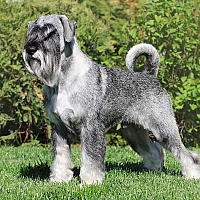
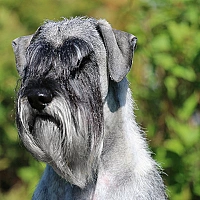
The "pepper and salt" coat is unique and found only in Schnauzers. Each guard hair has alternating dark and light zones: a dark tip, a light middle, and a dark base. The tip of the hair is usually black, the light zone is not white but silver, and the base of the hair is steel-colored.
The special feature of this color is that the same dog can look different depending on the time since the last stripping, after brushing, and even at different times of the year — the color can appear darker or lighter. And how the Schnauzer shines in the sun! It is as if there is a tiny LED inside every single hair. The dog glows from within!
What is the temperament of a Standard Schnauzer?
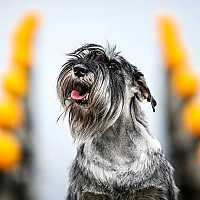
The Schnauzer is an active dog that knows how to keep its composure. By temperament, the Schnauzer is more of a sanguine type. They are enterprising, intelligent, cunning, and capable of adapting to their owner. This is not a soldier that acts only upon command, but an intellectual who is able to assess a situation and make their own decisions.
At the same time, the Standard Schnauzer is a companion dog, not a loner. A Schnauzer is ready to move mountains alongside its owner. When getting a Schnauzer, it is important to be prepared for a partnership-based relationship with the dog.
What is the size and weight of a Standard Schnauzer?
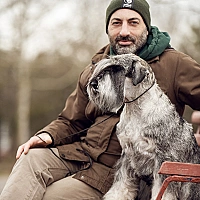
The height of an adult Standard Schnauzer at the withers is 45-50 cm. Females are closer to the lower limit, while males are closer to the upper limit. The weight of an adult dog averages 16-23 kg. A small, feminine female with a height of 45 cm weighs about 15-16 kg, whereas a large, powerful male can weigh 22-23 kg without being overweight.
How trainable are they?
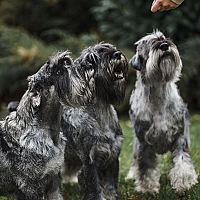
They are excellent to train. Their superb intelligence, drive, and stamina allow the Standard Schnauzer to be successful in various types of training, not just obedience. Schnauzers are known for their versatility. Among them, there are therapy dogs, search and rescue dogs, agility dogs, herding dogs, tracking dogs, and those trained for protection work.
The most important thing is that the dog must enjoy it. The Schnauzer is a driven yet thoughtful, fun-loving dog that is ready to conquer all sorts of peaks alongside its owner.
Is training mandatory for a Standard Schnauzer?
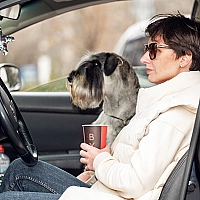
Training is optional, but upbringing is mandatory. A well-bred Standard Schnauzer knows how to behave correctly in various situations, understands what is allowed and what is not, and is comfortable to be around both at home and outdoors. Advanced command execution, scent work, or protection techniques are up to the owner's preference.
The Schnauzer is an easily trainable breed capable of achieving a great deal, provided the owner has the desire to pursue it.
Is a Standard Schnauzer suitable for beginners?
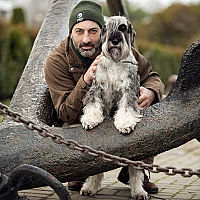
Yes, and proof of this can be seen in our puppies and their owners, for whom a Standard Schnauzer is their first-ever dog. A Schnauzer is not for everyone, just like any other breed. There is no such thing as a universal dog. If you are active, have a strong character, are balanced, purposeful, and ambitious—if it is important to you to see a personality in a dog and value a partnership—then prior experience does not matter.
You and your Standard Schnauzer will be looking in the same direction! Moreover, the Schnauzer is a breed that is easy to keep and care for.
Do these dogs have hunting instincts?
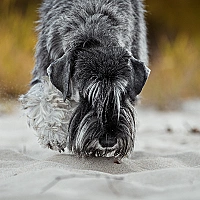
Hunting instincts exist to varying degrees in all dog breeds because all their ancestors procured food through hunting. A typical example is the chasing instinct, where a dog runs after a cat without intending to cause it any harm. Schnauzers, like most other breeds, have this. The main thing is that it is possible to work with this and correct such behavior.
Are the hunting instincts of a Schnauzer developed enough to make it a working hunting dog? No, the Schnauzer is not suitable for hunting.
We need a dog for protection. Is a Standard Schnauzer suitable?
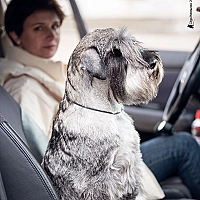
It depends on what you mean by a protection dog. If you need a dog that sits on a chain and barks, or a dog that patrols a territory at night and stays in a kennel during the day, then no, it is not suitable. However, if you need a guardian who will first and foremost be a friend to you and your family, and who is ready to protect when necessary, then a Standard Schnauzer is a great option.
If you plan to specifically train your Schnauzer for protection services (Schutzhund/IGP) in the future, please mention this when reserving a puppy. To work successfully against a person, a dog must possess specific natural traits that need to be considered when selecting a puppy.
How does a Standard Schnauzer treat strangers on the street and at home?
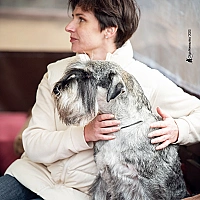
The Standard Schnauzer is wary of strangers. It is important to understand that wariness is not aggression. They quickly perceive the mood of any person, often even before their owners do. If friends visit you, the Schnauzer will act friendly and relaxed with them. If unfamiliar people come over, the dog will introduce itself and then observe their behavior.
On the street, the Schnauzer generally does not react to people passing by, but if it sees someone behaving strangely, it may decide that they are a threat to its owners. How this manifests depends on the dog's upbringing. That is why it is important to expose a young dog to various situations and different types of people.
How does a Standard Schnauzer treat children?
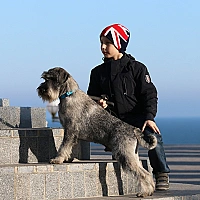
The Standard Schnauzer is safe for children of all ages. They will treat a newborn baby with great care and tenderness, may take the older child under their wing, and will be a friend to a teenager.
However, they will not agree to be a toy. If a Schnauzer finds a child's company unpleasant, they will try to avoid contact, but they will not display aggression.
We want to get a puppy now and are planning a baby in a year or two. How will an adult dog react to the arrival of a baby?
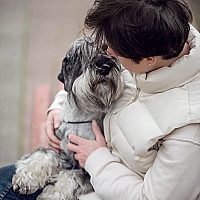
Your adult Schnauzer will welcome the newborn with tenderness, affection, and reverence. They will be willing to even take on the role of a nanny, and it will be safe for the child. This reaction is typical for both females and males. This has been the case in our own family, as well as in the families of our puppy owners.
Is a Standard Schnauzer suitable for elderly owners?
The Standard Schnauzer is an active and energetic dog, and it is also quite physically strong. Elderly people should understand that this breed requires at least a moderate level of physical activity and should realistically assess their abilities, both now and for the years to come.
Does a Standard Schnauzer choose one master, or is it a friend to the whole family?
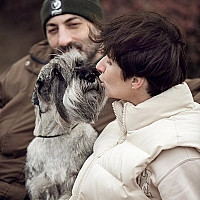
This breed is a companion for the entire family. A Schnauzer will very quickly integrate into your "human pack" and become a full-fledged member of the family. The Schnauzer has enough intelligence and wit to build individual relationships with everyone. They will respect and understand some people just by looking into their eyes, they will twist others around their little finger, and they will take others under their wing.
You will be amazed at how multifaceted a Schnauzer can be!
Is a Schnauzer suitable for outdoor living?
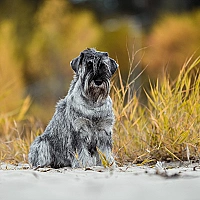
No, the Standard Schnauzer is not a dog for outdoor living. The purpose of a Schnauzer is to be a companion, which means being in the company of people. If you want a dog to live outdoors, please choose a different breed.
Is a Standard Schnauzer suitable for apartment living?
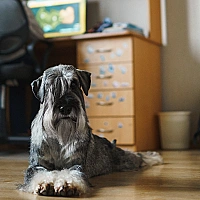
Undoubtedly. Their medium size, lack of "doggy smell," and absence of seasonal shedding make the Standard Schnauzer very convenient for living in an apartment. They will be a full-fledged member of your family thanks to their companionable nature, loyalty, and human-oriented personality.
What health issues do Standard Schnauzers have?
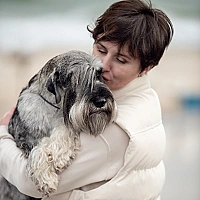
Standard Schnauzers are generally very healthy. For example, in 30 years, I have not had a single Schnauzer with a food allergy. There is no predisposition to gastrointestinal problems either.
Unlike many other breeds, Standard Schnauzers have only one genetic disease that is truly prevalent in the breed: DCM (dilated cardiomyopathy — a congenital hereditary heart disease that leads to chronic heart failure). How do you avoid buying a sick dog? It is very simple: you need to buy a puppy from parents with genetic tests for this disease. All Schnauzers in my kennel have official certificates from internationally recognized laboratories confirming the absence of DCM at a genetic level. If I breed my females with external males, it is mandatory that they also have a negative genetic test result. Therefore, I provide a guarantee against this disease in the puppies I breed.
Hip dysplasia also occurs in Standard Schnauzers. The percentage of dogs with dysplasia is small compared to large, heavy breeds, but it exists. I have my dogs X-rayed for dysplasia with official certification and only use healthy dogs for breeding. This minimizes the risk but does not eliminate it. Why? To this day, the hereditary nature of dysplasia has not been fully proven. Research suggests that while dysplasia can arise from a genetic predisposition, it is not the only factor. Living conditions and diet can also be contributing causes.
The good news is that dysplasia in Standard Schnauzers is rare. Furthermore, their relatively low weight, sturdy build, and well-developed musculature minimize clinical symptoms even in older dogs that may have this condition.
What kind of walks does a Standard Schnauzer need?
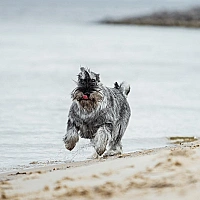
The Standard Schnauzer loves walks and active games with both people and other dogs. It is important to provide the dog with not only physical but also mental stimulation. This can include various types of training, learning new tricks, or puzzles and intelligence games.
What kind of physical activity can a Standard Schnauzer handle?
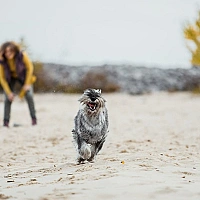
A Standard Schnauzer is capable of withstanding almost any physical activity an average person can do, and most importantly, they enjoy it. Regular 10 km runs are not a problem for a healthy adult dog. Whether it is running, cycling, hiking across rough terrain, skiing, sledding, or swimming, a Standard Schnauzer will happily keep you company.
Do Standard Schnauzers like to swim?
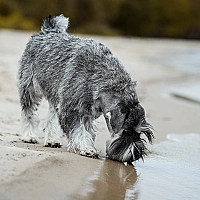
For the most part, yes. However, there are dogs that are wary of water. They are willing to swim alongside their owner, but they will not enter the water on their own initiative.
How does a Standard Schnauzer handle a hot summer?
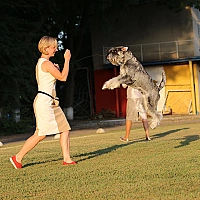
A Standard Schnauzer handles the heat quite well. While there is a risk of heatstroke or sunstroke for any dog, just as there is for humans, there is no need to keep a Schnauzer under air conditioning all summer long. In the summer, walk your dog during the morning and evening hours, do not leave them in direct sunlight, and NEVER, under any circumstances, leave them in a closed car!!!
We are at work all day. Can a Standard Schnauzer stay home alone all day?
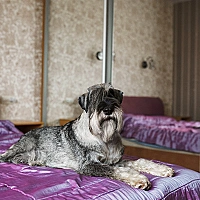
If you work without days off, come home late at night, and go straight to bed, then a Schnauzer is not the breed for you. If this happens only occasionally, a Schnauzer will be sympathetic and understanding.
What matters more is how active your lifestyle is outside of work. Will you be able to spend enough time with an active and companionable dog? It will be difficult for a young puppy to stay alone for long periods. They will get bored and lonely and will try to entertain themselves however they can. An adult dog can spend the whole day home alone, but in the evening, please do not forget to give your Schnauzer some quality time and play with them!
We have a cat at home. How do Standard Schnauzers get along with cats?
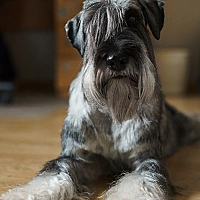
A puppy will try its very best to make friends with the cat. Some cats agree to be friends with the dog, while others do not. In any case, over time, they will establish a relationship in which both of them will feel comfortable.
Is it mandatory to hand-strip a Standard Schnauzer?
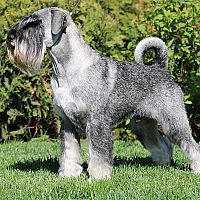
My advice is: hand-stripping is a must! The coat of a Standard Schnauzer is specifically designed for this type of grooming. Through hand-stripping, you get all the benefits of a wire-haired coat.
If a "pepper and salt" Schnauzer is clipped instead of hand-stripped, it will affect both the color and the quality of the coat. The hair will lose its banded coloration (agouti) and grow in a uniform gray, similar to the undercoat seen at the roots of a stripped dog. The coat will become softer, lose its tight fit, and the "armor-like" feel will disappear. Such a coat provides poorer protection against weather conditions, soaks through instantly, and fails to shield the dog from the wind. Without hand-stripping, you get a shaggy gray dog; with hand-stripping, you get a true Schnauzer with a gleaming, protective coat and a unique color.
Can we learn to hand-strip our dog ourselves?
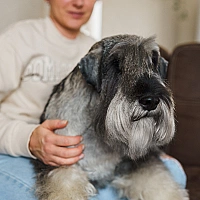
Theoretically, yes, you can. There is plenty of educational material, including literature, videos, seminars, and masterclasses. Grooming tools are widely available. The important thing is to understand what kind of result you want to achieve and how much time and effort you are willing to invest.
Quality breed-standard grooming is not just about "plucking here and clipping there"; it is akin to the work of a sculptor who creates a masterpiece from a block of stone by chipping away the excess.
What is the daily coat care for a Standard Schnauzer?
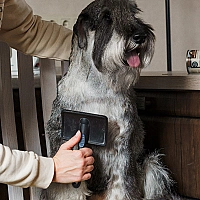
Daily care for a Schnauzer is simple and quick. In fact, it is more like weekly or even bi-weekly care.
The frequency of grooming depends on how tidy you want your dog to look. Body care comes down to hand-stripping (every six months or more often, preferably by a professional) and brushing out the undercoat (as needed, usually no more than once a month, which you can easily do yourself).
The wiry coat of a Standard Schnauzer does not mat, so it is usually enough to comb the "furnishings" on the beard and legs after washing while blow-drying. Washing the whole dog once a month and the furnishing hair once a week is enough to keep your Schnauzer clean, beautiful, smelling good, and ready to sleep on your sofa.
Of course, in bad weather, a Schnauzer might come back from a walk with mud dripping even from their ears... In such cases, rinsing with water or using a mild shampoo is sufficient. Important! Shampoos designed for wiry coats are not suitable for daily use! For frequent washing of the legs and beard, there are special mild shampoos. Then there are burrs and stickers, but removing them from a Standard Schnauzer is much easier and faster than, for example, from the fine, long hair of a Maltese.
Can we feed a Standard Schnauzer a natural diet?
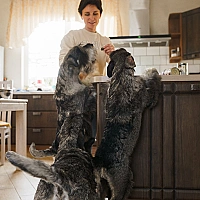
Yes, but it is important to understand that a natural diet is not porridge. It is primarily meat (chicken, turkey, beef, horse meat). Only a small portion of the diet consists of vegetables, dairy products, and saltwater fish. It is crucial that the diet is balanced not only in terms of proteins, fats, and carbohydrates but also vitamins and minerals. You will definitely need ready-made supplements. Whether it is worth the effort is up to you to decide.